
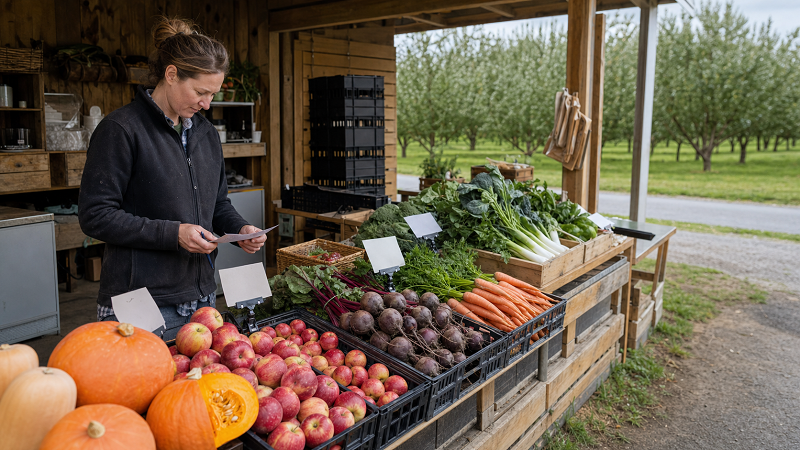
How to Grow a Roadside Produce Stall: A 6-Week Improvement Plan
A good produce stall rarely grows because the owner adds more of everything. It grows because passing traffic can understand the offer quickly, the best products are reliably available, the price covers the real work, and customers have a reason to return.
Diagnose the bottleneck before buying anything
Stand where a first-time customer arrives and time five seconds. Can they answer these questions?
- Is the stall open?
- What are the three main things sold here?
- What does each cost?
- How do I pay?
- Where can I stop safely?
If any answer is unclear, fix that before adding products, shelving or advertising. Confusion suppresses every product at once.
Choose three roles for your range
A disciplined stall range has jobs:
- Anchor: the dependable product people make the trip for—eggs, apples, potatoes, citrus or a signature preserve.
- Seasonal reason to return: the changing product that creates interest—berries, asparagus, tomatoes, sweetcorn or feijoas.
- Basket builder: the easy add-on that fits the same meal or occasion—herbs beside tomatoes, lemons beside honey, or onions beside potatoes.
Keep experiments small. One new line observed properly teaches more than six new lines lost in clutter.
Price from the bottom up
Competitor prices are information, not your cost sheet. For each saleable unit, include:
- seed, plants, feed or purchased ingredients;
- growing, harvesting and preparation time;
- packaging and labels;
- card or payment fees;
- expected unsold, damaged or stolen stock;
- stall overheads and a contribution to equipment;
- a margin that makes the work worth repeating.
Minimum sustainable price = full unit cost ÷ (1 − target gross-margin rate).
Suppose a bag has a full unit cost of $4.20 and the stall needs a 30% gross margin to contribute to overhead and profit. The calculation is $4.20 ÷ 0.70 = $6.00. This is a hypothetical teaching example, not a suggested market price.
If the result feels too high, do not simply erase labour or waste. Change the unit, process, pack size or product mix. Business.govt.nz recommends checking that prices cover costs while also making sense for customers and your market; its price and place guide is a useful companion.
Use four numbers every week
| Measure | Formula | What it reveals |
|---|---|---|
| Sell-through | Units sold ÷ units offered | Whether stock level matches demand |
| Waste rate | Unsaleable units ÷ units offered | The cost of overstocking or weak handling |
| Average basket | Sales revenue ÷ transactions | Whether products work together |
| Contribution per display space | Gross contribution ÷ crate or shelf position | Which products deserve the clearest space |
Do not confuse sell-through with profit. Selling every bag below full cost creates work, not a business.
Make the approach do the selling
Good stall design reduces decisions:
- Show the anchor product first and at a comfortable height.
- Use large, high-contrast price information readable before a customer handles stock.
- State the unit clearly: each, bunch, punnet, bag or kilogram.
- Keep payment instructions beside the place where payment happens.
- Remove empty crates, stale notices and props that compete with the produce.
- Make access, stopping and pedestrian movement safe and obvious.
Photography matters online. Use a current, well-lit photo that shows the stall customers will actually find. Create or claim your Country Stalls listing through Join Country Stalls, and read How It Works for Sellers to connect the physical stall with search, map and marketplace discovery.
Turn freshness into an operating rhythm
Customers cannot see your harvest plan, but they experience its results. Set a simple rhythm:
- Opening check: remove damaged items, clean surfaces, photograph the display if useful, and count starting stock.
- Mid-session check: face up the display, move delicate produce out of heat, and record fast movers.
- Closing check: count sales and remaining stock; sort into sell tomorrow, use/process, donate/share where suitable, and discard safely.
For packaged food, use clean, intact, fit-for-purpose materials that protect the food. MPI’s food packaging guidance explains the principles and applicable rules.
Create a return loop, not a one-off promotion
A discount can move stock, but it does not automatically create loyalty. Give customers dependable reasons to check again:
- state normal restock days without promising what weather may prevent;
- show what is “coming next” in the season;
- offer two useful pack sizes instead of a maze of discounts;
- pair products around a meal;
- invite one specific piece of feedback: “Would you prefer a smaller bag?”
If you operate unattended, the honesty-box stall guide covers clarity, payment, stock control and trust in more depth.
The six-week improvement plan
| Week | Change one thing | Measure |
|---|---|---|
| 1 | Establish starting stock, transactions, revenue and waste | Baseline only |
| 2 | Rewrite the entrance message around the three main products | Stops and transactions |
| 3 | Move the anchor to the clearest display position | Anchor sell-through |
| 4 | Test one pack-size or price presentation | Average basket and margin |
| 5 | Add one logical basket-builder | Multi-item transactions |
| 6 | Update the online listing and photo | Direction requests, views or customer mentions |
Change one major variable at a time so the result teaches you something. Weather, roadworks and harvest fluctuations will muddy the data; six weeks is a learning cycle, not a scientific trial.
What growth should feel like
Healthy growth is not only higher revenue. It can mean less waste, fewer emergency restocks, a clearer range, better margins, more repeat customers and less time explaining how to pay. When the stall is easier for you to run and easier for a stranger to use, growth has somewhere solid to land.