
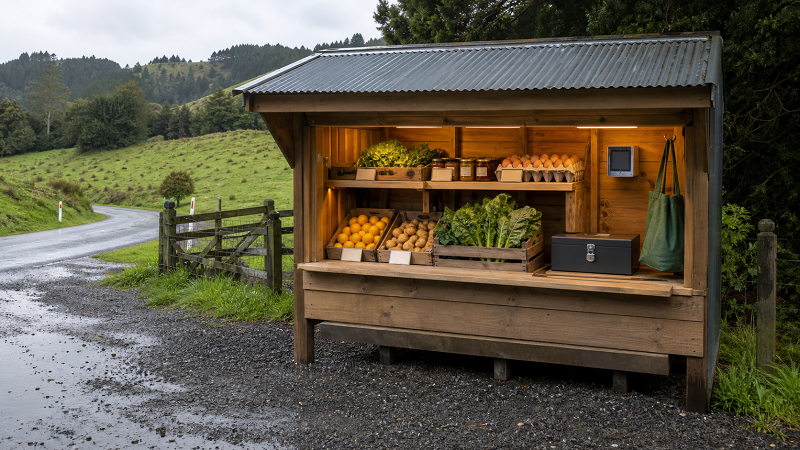
The Honesty-Box Stall Playbook: Trust, Payments and Stock Control
An honesty-box stall is a tiny self-service shop. Trust matters, but trust works best when the stall removes ambiguity: customers can see what is for sale, understand the unit and price, pay without guessing, and leave knowing they did the right thing.
Design for a first-time customer at speed
A driver who stops on impulse should be able to complete the purchase without calling you. Work through the experience in order:
- Safe arrival: the stall is visible in time and the stopping area is suitable.
- Open or closed: the state is unmistakable; empty shelves do not look like an open stall.
- Product and unit: “$5 per bag” cannot be mistaken for $5 per kilogram or per item.
- Payment: instructions are beside the payment point and alternatives are explicit.
- Departure: bags, change policy and any handling notes are clear before the customer leaves.
Do not make one hand-written notice carry the entire system. Use a simple hierarchy: open state, products, prices, payment, contact.
Stock less, replenish intelligently
A full-looking stall does not need all available stock exposed. Use shallow display crates and replenish based on temperature, traffic and the product’s tolerance.
- Keep delicate greens, berries and eggs protected from unsuitable heat and direct sun.
- Rotate the oldest sound stock forward and remove damaged items promptly.
- Use smaller batches during unfamiliar traffic periods.
- Close or remove a line when you cannot keep it in suitable condition.
For food businesses, MPI emphasises training, cleaning and sanitising, separation, and correct temperature control as core food-safety practices. Its food safety toolkit is the right place for current guidance.
Use a stock-and-payment reconciliation
You cannot manage an unattended stall from the cash total alone. Record beginning stock, additions, ending stock, known waste and expected revenue.
Expected units sold = opening stock + restock − closing stock − recorded removals.
Variance = expected revenue − recorded payments.
Track the variance by day and product, not by emotion. One short payment can be a mistake; a repeated pattern on a particular shift may point to unclear pricing, payment friction, poor counting or theft. Better data prevents an angry sign being aimed at every customer.
A one-page daily log
| Time | Product | Added | Removed/waste | Remaining | Notes |
|---|---|---|---|---|---|
| Open | Anchor line | Count | — | Count | Weather/display |
| Midday | Seasonal line | Count | Count | Count | Restock reason |
| Close | All lines | — | Count | Count | Payments/variance |
Offer payment methods you can reconcile
Cash can be familiar and fast; electronic payment can help customers without the right change. Each option creates work:
- Cash: use a secured, tamper-resistant box; decide and state whether change is available.
- Bank transfer: make the reference instruction short enough to follow; reconcile deposits consistently.
- QR or payment link: use a legitimate, maintained payment destination and check the displayed code has not been replaced or damaged.
- Contactless terminal: consider connectivity, power, weather protection, fees and physical security.
Do not display more methods than you can monitor. A customer should never wonder whether a payment worked or what reference to use.
Build trust with evidence, not sentiment
“Please be honest” asks for goodwill. A well-run stall demonstrates that the seller is participating too:
- fresh, clean stock and accurate units;
- prices that match every place they appear;
- a contact method for genuine problems;
- clear handling or storage information where needed;
- current photos and opening information online;
- prompt correction when something is wrong.
List or claim the stall through Country Stalls, and keep its details aligned with the physical site. If a shopper has discovered an unlisted stall, they can use I Found a Stall to put it on the community’s radar.
Respond to losses in the right order
- Verify the count. Check restocks, household removals, spoilage and payment timing.
- Remove friction. Clarify price, unit and payment confirmation.
- Reduce exposure. Put out smaller batches or close earlier during weak periods.
- Improve physical security. Secure the cash box and payment signage; maintain appropriate visibility.
- Change the model if needed. Staff the stall at peak times, offer pre-orders, or sell high-risk lines through a different channel.
Aggressive blanket surveillance or accusatory notices can damage the experience for honest customers and may create privacy or safety issues. If you consider cameras, signage or collecting personal information, get current New Zealand privacy and legal advice for your situation.
Prepare for weather and outages
Write a small closure checklist for wind, rain, heat, power failure and connectivity loss:
- which products must be removed first;
- how electronic-payment downtime is communicated;
- where signs and loose items are secured;
- how pooled water, mud or low visibility affects safe access;
- who can close the stall when you are away.
Packaging must be clean, intact, fit for purpose and able to protect food from contamination and deterioration. Review MPI’s packaging guidance when choosing bags, punnets, cartons or jars.
A weekly 20-minute audit
- Buy one product exactly as a stranger would.
- Check every price against the payment instructions.
- Test the electronic payment path without exposing sensitive information.
- Inspect the cash box, roof, shelves, lighting and stopping area.
- Review sell-through, waste and payment variance.
- Update the online listing if hours, stock pattern or access changed.
For a broader commercial plan, continue with How to Grow a Roadside Produce Stall. For the customer view, How to Shop Local in New Zealand explains the clarity and freshness signals that turn a first stop into a repeat visit.